Le Marais
The Wife He Threw Away: A Billionaire Secret Baby, Marriage-in-Crisis, Second-Chance Grovel RomanceLe Marais is the decisive urban setting of Ada Hart’s transformation. In its streets, rented rooms, ateliers, cafés, and locked shopfronts, pregnancy, poverty, artistic labor, motherhood, and commercial independence become parts of one continuous struggle. The district first receives Ada as an abandoned and physically vulnerable woman, then becomes the ground from which she establishes Maison Cendre, protects Theo Hart, and eventually negotiates with Sebastian Vale and Vale Group on terms she has written herself.
Exile and Material Survival
Le Marais does not romanticize Ada’s departure. She is sick every morning over a chipped sink, with nausea that has become a permanent tenant, and she has only eleven hundred euros left. The district’s gilded balconies, geraniums, and golden light along the rue des Rosiers coexist with cold tile, hunger, and the practical terror of having no secure resources. Paris does not care that she is suffering, and that indifference becomes the first discipline of her new life: the city offers neither rescue nor recognition, so Ada must create both for herself.
Her refusal of Sebastian’s money gives the district an immediate economic meaning. In an internet café smelling of scorched espresso and cigarettes, she sees seven-figure joint accounts and a card capable of paying for an Île Saint-Louis apartment, but closes the account because every euro bears Sebastian’s name and the name he once told her was never hers. Instead, she rents a sixth-floor room in Le Marais, with no lift, a light-well window, and a mattress that has already belonged to too many bodies. To raise the deposit, she sells the jasmine studs Sebastian gave her after Grasse; the pawnbroker on the rue de Turenne offers ninety euros, and she accepts without allowing her voice to reveal what the sale costs. The district therefore records independence not as an abstract ideal but as a sequence of bodily and material choices.
A District Read Through Scent
Ada’s way of inhabiting Le Marais is sensory and professional at once. When money fear becomes too loud, she walks for hours and reads Paris by scent: fresh figs and diesel on the rue de Bretagne, the green-mineral breath of the Seine near the Pont Marie, and the butter and burnt sugar exhaled by a boulangerie. She cannot afford what she smells, but she can name it, and naming becomes a form of ownership that no contract can revoke. With no laboratory, she constructs formulas in her head as she moves through the streets, turning the district into an invisible organ of raw materials and memory.
A shuttered parfumerie on a side street off the rue Saint-Claude becomes a particularly concentrated version of that experience. Its windows are soaped white, its wrought-iron sign remains, and the old glass preserves a whisper of orris, civet, and a century of women’s wrists. Ada stands beneath it and breathes as though approaching a locked church. One Thursday, after not eating since the previous morning, she walks toward the shop and collapses on the cobbles. The street tilts, the gold light turns granular, and the old perfume rises around her as she fears for the child she has claimed as the one thing that is hers. Le Marais thus holds both the imaginative freedom of scent and the physical danger produced by poverty and pregnancy.
The Hidden Home of Maison Cendre
Le Marais becomes more than a refuge after Estelle shelters Ada. When Ada offers no trustworthy name and no verifiable story, Estelle does not force the truth from her; she offers a cot above the atelier, warns that the workshop’s smell will enter her sleep, and gives her the organ in the mornings before she rises at six. The arrangement makes space itself part of the rescue. Ada’s new life is not built through a return to respectable domestic security but through access to a working room, a mentor’s tools, and a place where her nose can operate without Sebastian’s authority.
The district also becomes the site of Ada’s solitary labor and motherhood. Her contractions last eleven hours in Estelle’s parlor, with no husband in the corridor and no hand to crush in hers. At dawn, her son arrives with shockingly copper hair, and Ada’s life in Le Marais acquires its protected center. Four years later, Maison Cendre occupies a quiet corner of the district in a seventeenth-century hôtel particulier, with a courtyard the color of weak honey and a plaque that makes passersby slow down. Ada names the house Cendre, or ash, to remember what she was working with when she began; by then, the name signifies not ruin but a fragrance house whose future the great houses want to know.
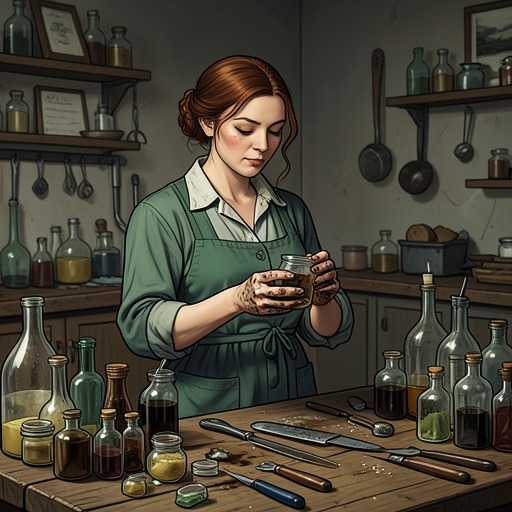
The atelier embodies the reversal. It smells of cool stone, drying orange flower, and the animal warmth of ambers behind glass. The organ that once held two hundred essences in Sebastian’s secret kingdom now runs along Maison Cendre’s north wall with three hundred essences, each keyed by Ada’s own hand. There are no thumbprint locks and no hidden kingdom belonging to someone else. Everything carries her name openly. Le Marais gives physical form to the difference between being permitted to create and owning the conditions of creation.
Public Credit and Private Protection
Ada’s relationship with the district is deliberately divided between public absence and private visibility. In public she uses Adeline Rousseau, her mother’s maiden name, which Vale Group has never touched. She avoids parties, photographs, and the press, allowing Paris to invent her as reclusive, difficult, or ghostlike. The invented ghost is useful because it places a wall between the world and the copper-haired boy sleeping nearby. Le Marais becomes a protective enclosure in which anonymity is not shame but a strategy for keeping Theo safe.
Her authorship, however, is never hidden. Every Maison Cendre flacon, ledger, and press line carries the credit “A composition by A. Rousseau.” Ada refuses a muse, a white-clad public surrogate, or any repetition of the earlier theft in which another woman’s name occupied the place her work deserved. Delphine Cross handles buyers, profiles, and men investigating a house run by two women without dynastic backing, while Ada remains at the bench with Estelle’s organ. The district’s commercial rise therefore preserves a strict distinction: Ada conceals her face but insists that her work be named.
The Blue Door and the Return of Conflict
Le Marais eventually draws Sebastian back into the story. He moves his meetings, delays people in Milan, and begins orbiting Maison Cendre’s narrow blue-doored street on the rue de Poitou. He tells himself that he is not there to confront Ada, only to see one unguarded moment in which the truth might become visible. For three days he sees Delphine Cross carrying sample cases and Ada at the window with a blotter to her nose. On the fourth day, he sits across the street in a café, orders coffee he does not drink, and waits.
At twenty past four, the blue door opens. Ada emerges with her coat over her arm, laughing at something below her sightline; the laugh recalls the laughter from the Grasse jasmine fields that Sebastian believed he had destroyed. A small boy with copper hair follows her and takes her hand. The street between Sebastian and the doorway becomes the visual measure of the four-year separation: Le Marais has made a life he cannot enter merely by recognizing its resemblance to himself.
When Sebastian later comes to the atelier, his presence among copper stills and racked blotters exposes the conflict between the wealth of Vale Group and the life Ada has built in Le Marais. She permits the possibility of business—distribution or a house account, handled by contracts and lawyers—but rejects acquisition, pursuit, bought-out restaurants, and his presence outside Theo’s school. The district is where she turns proximity into a boundary: Maison Cendre may deal with Vale Group on paper and at arm’s length, but neither the wife nor the child is available as a purchase.
From Refuge to Negotiating Power
Le Marais changes again when Ada brings its hard-won independence into the boardroom. She proposes a merger of equals between Maison Cendre and Vale Group’s fragrance division, requiring her house, formulas, and name to appear publicly and permanently in the founding documents. Chloe Beaumont’s name must be removed from the relevant materials, and Ada demands fifty-one percent control of the division bearing her perfumes. Her position is not a plea to be restored to the old world; it is an attempt to prevent the old world from reproducing the conditions that drove her into exile.
The district’s significance lies in this accumulated reversal. Its rented room, cafés, cobbles, shuttered parfumerie, blue door, and atelier are stages in a movement from dependence to refusal. Ada arrives with forty euros, no papers in her own name, a hidden pregnancy, and a body weakened by hunger; she remains long enough to create an address, a public credit, a protected child, and a business capable of setting terms for Vale Group. Le Marais is therefore not merely where Ada hides. It is the place where concealment becomes authorship, scarcity becomes discipline, and a life built from ash becomes powerful enough to negotiate as an equal.